Vimshottari Dasha
Understand major and minor planetary periods that shape the current life phase and timing of results.
Questions this guide answers
- What phase of life am I in?
- Why does this period feel intense?
- Which planet period is active?
- How do I read Mahadasha and Antardasha?
Before you begin
- Create or select a birth profile with date, time, and place of birth.
Step by step
- 1
Find the active Mahadasha
Start with the highlighted major period and its start and end dates. It is the long background chapter.
Expected result: The highlighted Mahadasha and its start and end dates are visible.
- 2
Open the active Antardasha
Drill into the sub-period to see the current emphasis inside the Mahadasha.
Expected result: The active Antardasha is open within its parent Mahadasha.
- 3
Use smaller periods carefully
Read Pratyantardasha and deeper levels as shorter emphasis, not as stronger evidence than the parent periods.
Expected result: The selected smaller period is visible within its parent-period hierarchy as a shorter emphasis.
- 4
Compare chart strength
Check each active lord in the D1 chart, D9, and the divisional chart relevant to the question.
Expected result: Supporting or conflicting evidence for the active lords is identified across D1, D9, and the relevant divisional chart.
- 5
Generate a period reading
Use the prediction action for the selected period, then treat the dates as a window rather than a guaranteed event.
Expected result: A reading for the selected period is visible with its date window, or a clear generation error is shown.
Watch the walkthrough
Identify the current major period and open its sub-period sequence without deterministic claims. The active Mahadasha and its Antardasha sequence are visible in timeline context.
Read transcript
Open Vimshottari Dasha with the intended profile active. The highlighted row marks the current Mahadasha, or major planetary period.
Open the active row to see its Antardasha sequence and smaller sub-periods. Read the start and end dates before relating a period to a life theme.
Dasha describes timing context and emphasis, not a guaranteed event. Compare it with the Birth Chart and current circumstances.
Concept diagram
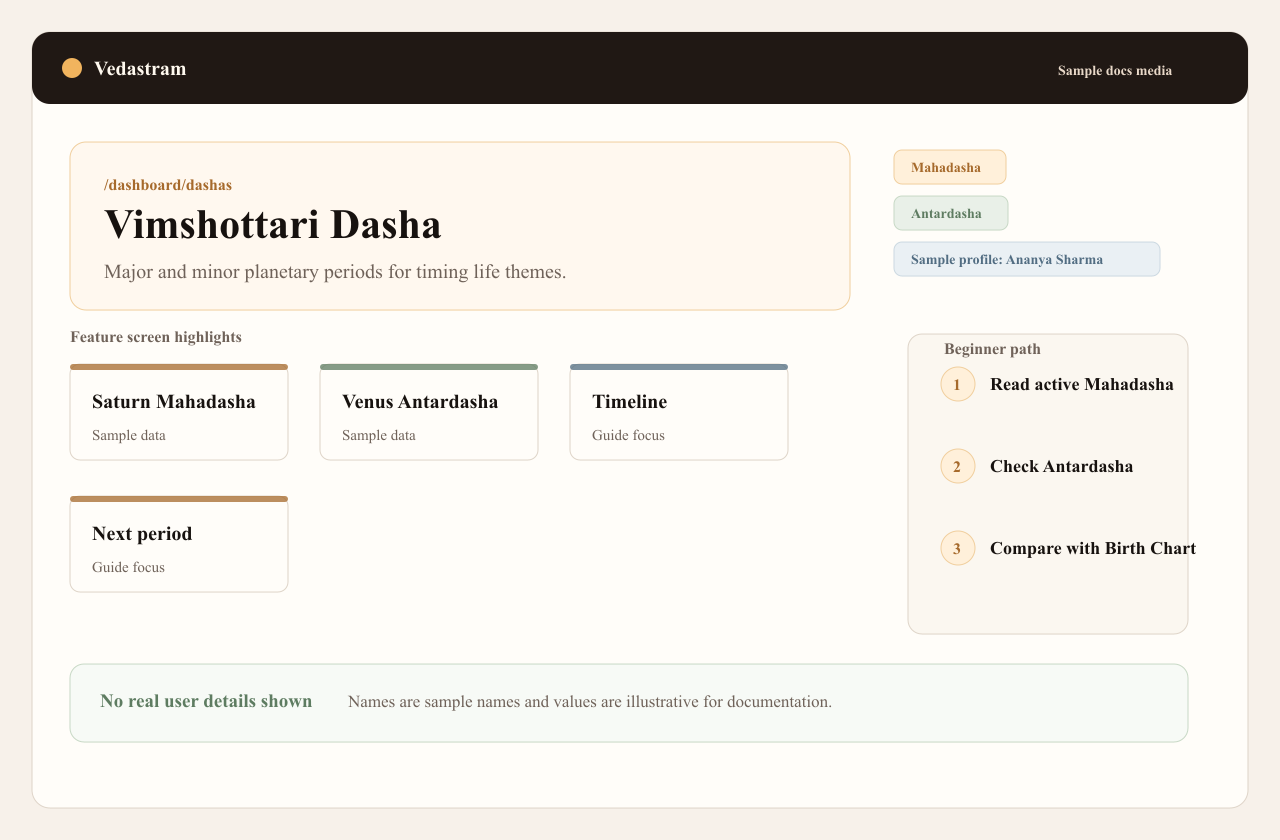
What Dashas explain
Dasha is the timing layer. It shows which planetary themes are active now and which sub-period is refining the result.
Use this page before judging whether career, relationship, money, family, or inner work topics are naturally activated right now.
How to read the timeline
Start with the active Mahadasha. That is the long background chapter. Then read the active Antardasha as the current sub-theme.
If the page shows smaller nested periods, read them as short-term emphasis. Do not treat a short sub-period as stronger than the main Mahadasha.
What beginners should compare
Compare the active planet with its house, sign, dignity, and nakshatra in Birth Chart. A strong, well-placed planet usually expresses more constructively.
After identifying the active period, use Ask and reports for one focused question like how should I handle Saturn Antardasha for career.
Common mistakes
Do not read a Dasha period as a guaranteed event. It is a timing signal that still depends on the birth chart, transits, choices, and context.
Do not jump to difficult predictions from one planet name. Always check placement and supporting factors first.
Troubleshooting and recovery
Period dates differ from another astrology program
Confirm the ayanamsa, Moon longitude, node convention, timezone, and Dasha year-length convention. Vedastram uses the configured engine convention; even small Moon differences shift the balance.
A difficult planet name causes concern
Do not judge a period from the planet name alone. Review its lordship, placement, dignity, aspects, relevant varga, and supporting timing.
Frequently asked questions
Does an active Dasha guarantee an event?
No. It activates themes and timing potential. The natal promise, divisional confirmation, transits, circumstances, and choices still matter.
Terms used in this guide
- Mahadasha
- The major planetary period, usually the main chapter of timing.
- Antardasha
- The sub-period inside a Mahadasha.
- Pratyantardasha
- A smaller period inside the Antardasha, useful for shorter timing windows.
Did this guide help you complete the task?
Owner: Vedastram Product Education